INT Research
A vision: integrating levels of investigation around a set of functional questions
How are sensory signals encoded, integrated, and transformed into the neural representations that support perception and guide goal-directed action? How do emotion-regulation processes, implemented through interactions between limbic, paralimbic, and prefrontal control systems, shape social inference, communication, and interpersonal behavior? How do distributed neural circuits, spanning synaptic and cellular mechanisms to large-scale network dynamics, give rise to behavior and enable adaptive updating under changing physiological states (e.g., arousal, homeostatic needs) and environmental constraints? How are these multilevel mechanisms altered in neurological and psychiatric disorders, from molecular and circuit-level dysfunction to impairments in cognition and social functioning?
The ambition of the INT is to address these questions through an explicitly integrative, functionally grounded framework that bridges levels of analysis – from molecular signaling and synaptic plasticity, to systems neuros cience and computational modeling, to cognition and its pathologies – while leveraging converging methods to establish mechanistic links between brain, body, and environment.
—————————————————————-
Our main research areas
Since its founding, INT has chosen to focus on a limited number of cognitive functions and neural networks, investigated across multiple scales—from molecular mechanisms to behavior—in both humans and animal models.
Action, Perception and Emotion
This integrative approach aims to understand how the brain generates adaptive behavior by addressing the mechanisms underlying spinal, subcortical, and cortical control of segmental and oculomotor systems; low-level visual and auditory representations; and the contribution of emotion-regulation systems. These questions are also explored in their pathological dimensions, by bridging approaches across neurological, psychiatric, and neurodevelopmental disorders.
Exploring the organization of the brain and spinal cord across scales
Our aim is to understand the anatomical and functional architecture of the networks that drive the dynamics of these behaviors: how neuronal diversity, flexible neuronal assemblies, functional maps, and large-scale cortical networks enable the emergence of action and perception, as well as our interactions with others.
A biological brain within a living organism
Going beyond classical cognitive neuroscience, our teams investigate these functions from a physiological perspective. How are neural circuits modulated by the body’s internal state? How do inflammatory processes contribute to circuit disruption and to adaptive or maladaptive plasticity? How do typical and atypical developmental trajectories shape the structure and function of the nervous system? Several of our teams address these questions through fundamental, translational, and clinical research—always grounded in the major functional domains studied at INT.
Imaging and manipulating the brain across different scales
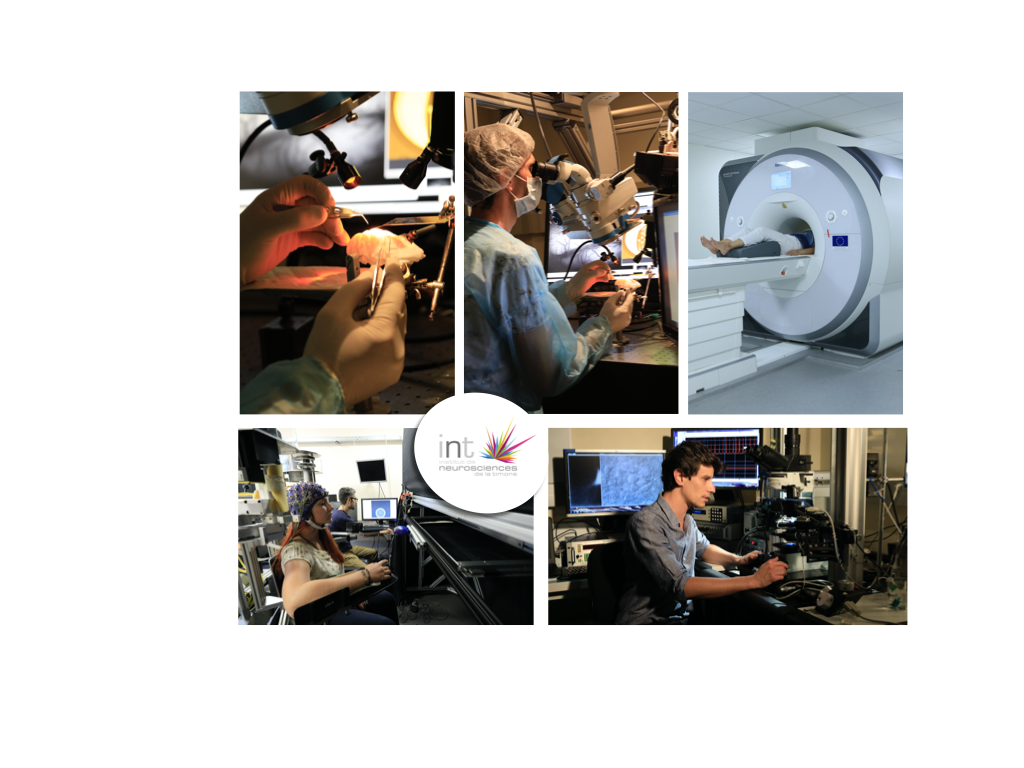
To investigate the structure and functional organization of neural circuits, our teams combine multi-scale imaging (microscopy, MRI), electrophysiology (microelectrodes, EEG, MEG), and behavioral approaches (sensory psychophysics, cognitive science, motor control) in both animal models and human participants. Through INT’s NeuroTechCenter, our teams collaborate with physics, photonics, and computer science laboratories at Aix-Marseille Université and Mines Saint-Étienne to master these tools, develop new ones, and make them available to the wider scientific community.
Computational and theoretical neuroscience
Modeling the organizing principles of the nervous system, deciphering the neural code, and identifying the computational and theoretical foundations of neuronal dynamics are central challenges in modern neuroscience. Our teams develop theoretical and computational methods grounded in information theory, machine learning, and artificial neural networks to analyze data and model brain function in both health and disease. They work closely with partner research units (INS, LIS, INMED) within CoNeCT, an interdisciplinary center dedicated to theoretical and computational neuroscience.
——————————————————————–
INT Research Teams
A research team brings together scientists, clinicians, technical staff, and students around a clearly defined five-year research program. Within teams and across the institute, INT actively promotes collaboration and interdisciplinarity to address major challenges in theory, experimentation, and technology development. In 2026, INT comprises 14 research teams.
INT Research Platforms
Our technological resources are organized into seven platforms that provide both technical expertise and dedicated staff support for the delivery of our scientific projects. These platforms are widely open to external users and collaborators.